One idea in.
One winning product out.
Most founders skip validation because they're scared of what they'll find. This is the process they should have run instead.
Nine framework-backed decisions, in a fixed order, that turn a vague idea into a ship-ready playbook. Buyer. Pricing. Scope. Launch. Decided in days, not months — before a single line of production code gets written.
This walkthrough is the companion to Validate your business idea — the full written 9-step playbook. Each stage below links to a deep-dive on that decision.
- 1
Worth Building?
→ Market verdict 2–3 minAnalyze your idea against real market data to determine if there's genuine demand worth pursuing.
CB Insights finds 35–38% of failed startups cite "no market need" as the cause. Stage 1 is the gate that catches them.
Deep-dive: Pre-launch market researchYou leave with- TAM/SAM/SOM analysis
- Competitor landscape
- Market verdict
Some of the frameworks usedTAM/SAM/SOM AnalysisPorter's Five ForcesMarket Timing AnalysisMarket Context AssessmentStage 1 output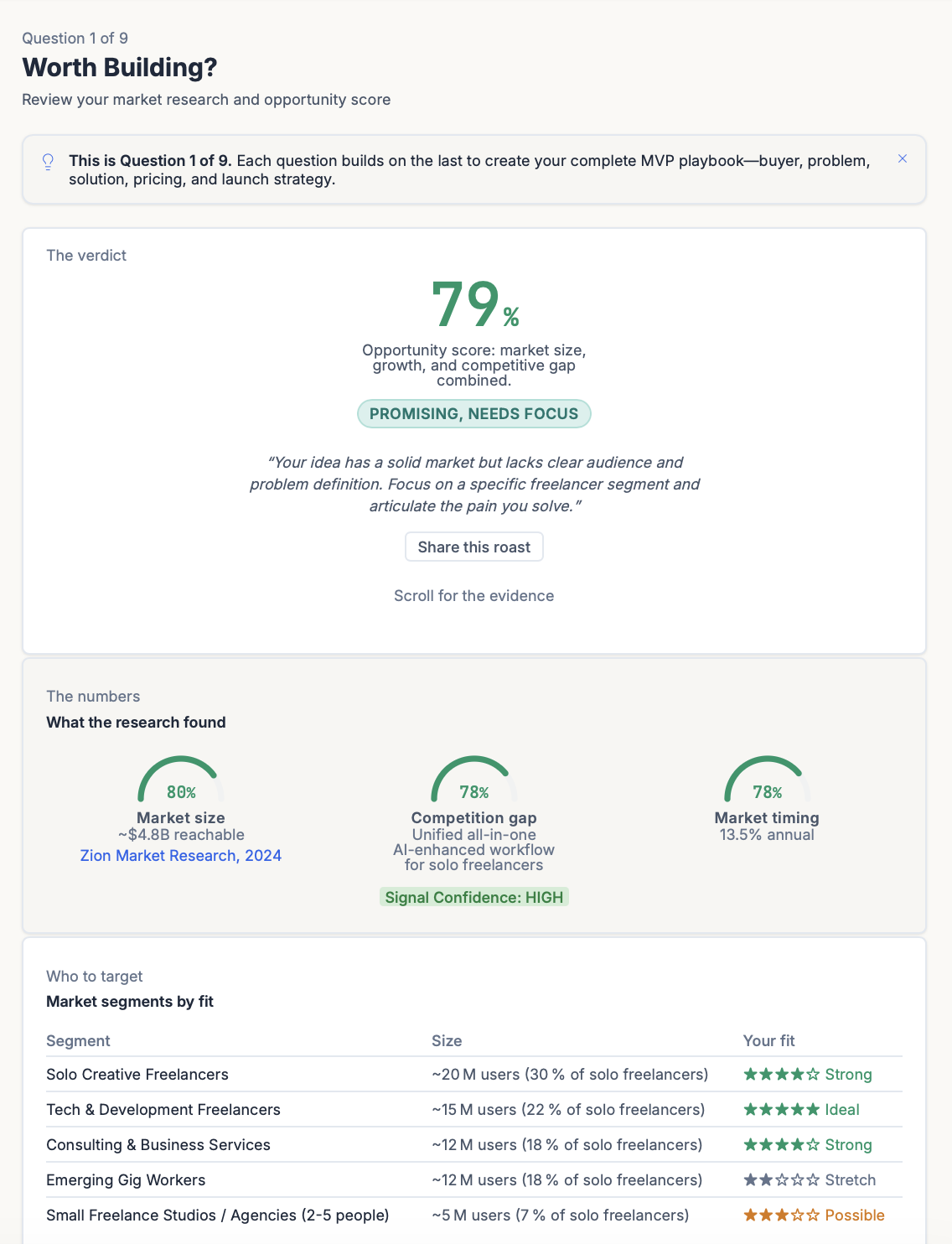
- Start free
Try Stage 1 free — get your market verdict
No credit card. 3 free credits to start.
- 2
Who Pays?
→ Primary buyer 3–4 minIdentify your ideal customer profile and understand who actually has budget authority.
LTV/CAC ≥ 3 is the SaaS scaling threshold (David Skok). The buyer persona output ties to economics, not demographics.
Deep-dive: Idea validation & the buyerYou leave with- Buyer personas with economics
- Willingness-to-pay analysis
- LTV/CAC estimates
Some of the frameworks usedProto-Personas FrameworkEthnographic Empathy MapsJobs-to-be-Done (JTBD)Unit Economics (LTV/CAC)Emotional Friction StatesAEIOU FrameworkStage 2 output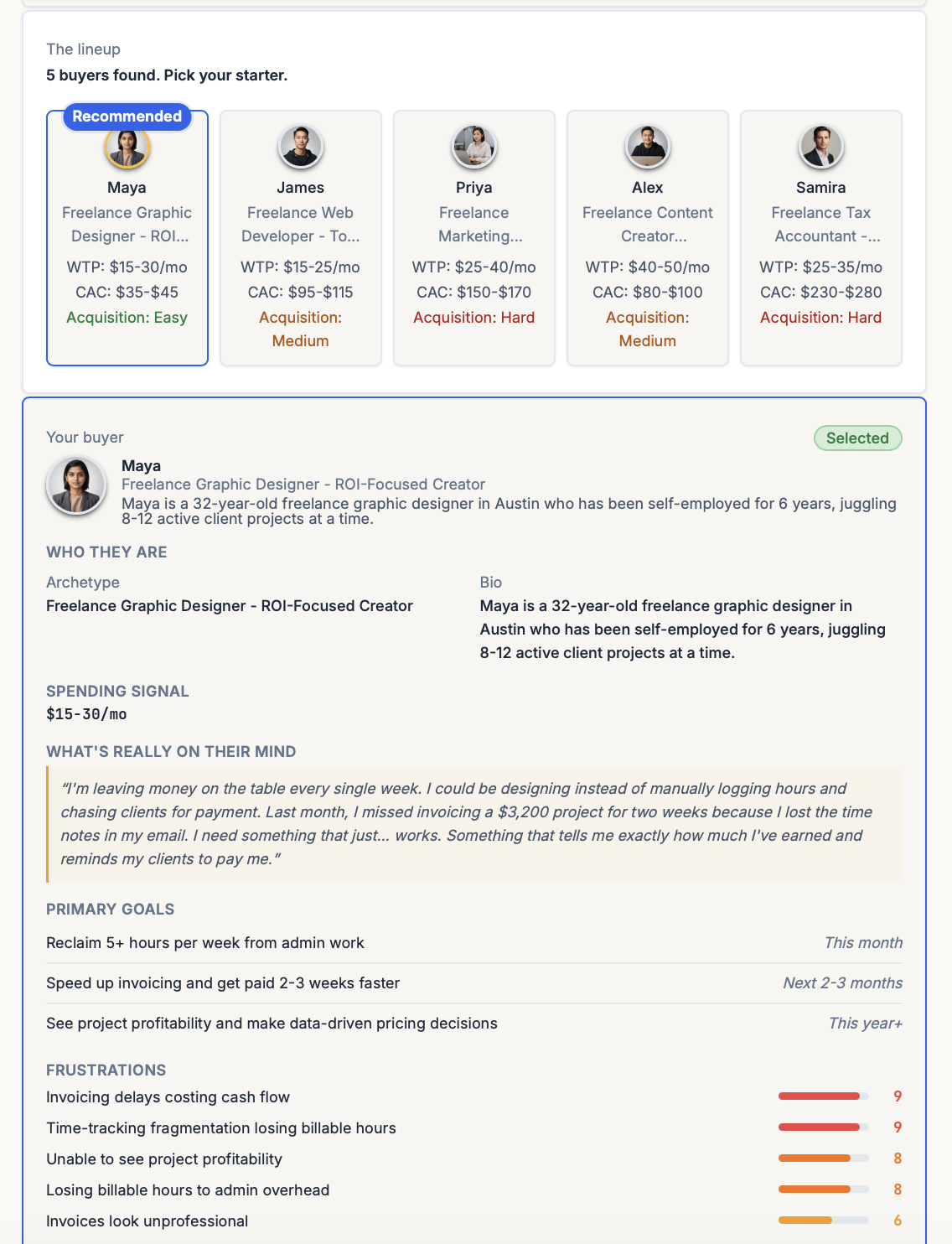
- 3
What Hurts?
→ Core problems 4–5 minUncover the real pain points your customers face. Not what they say, but what they actually experience.
Mom Test signal emerges around 10–15 interviews — when 3+ unrelated buyers describe the same pain in the same words.
You leave with- Ranked pain points
- Severity scoring (frequency × intensity)
- MVP problem selection
Some of the frameworks usedProblem Scoring FormulaEmotional Friction States HierarchyAEIOU FrameworkDo-Say Gap AnalysisThe Mom TestStage 3 output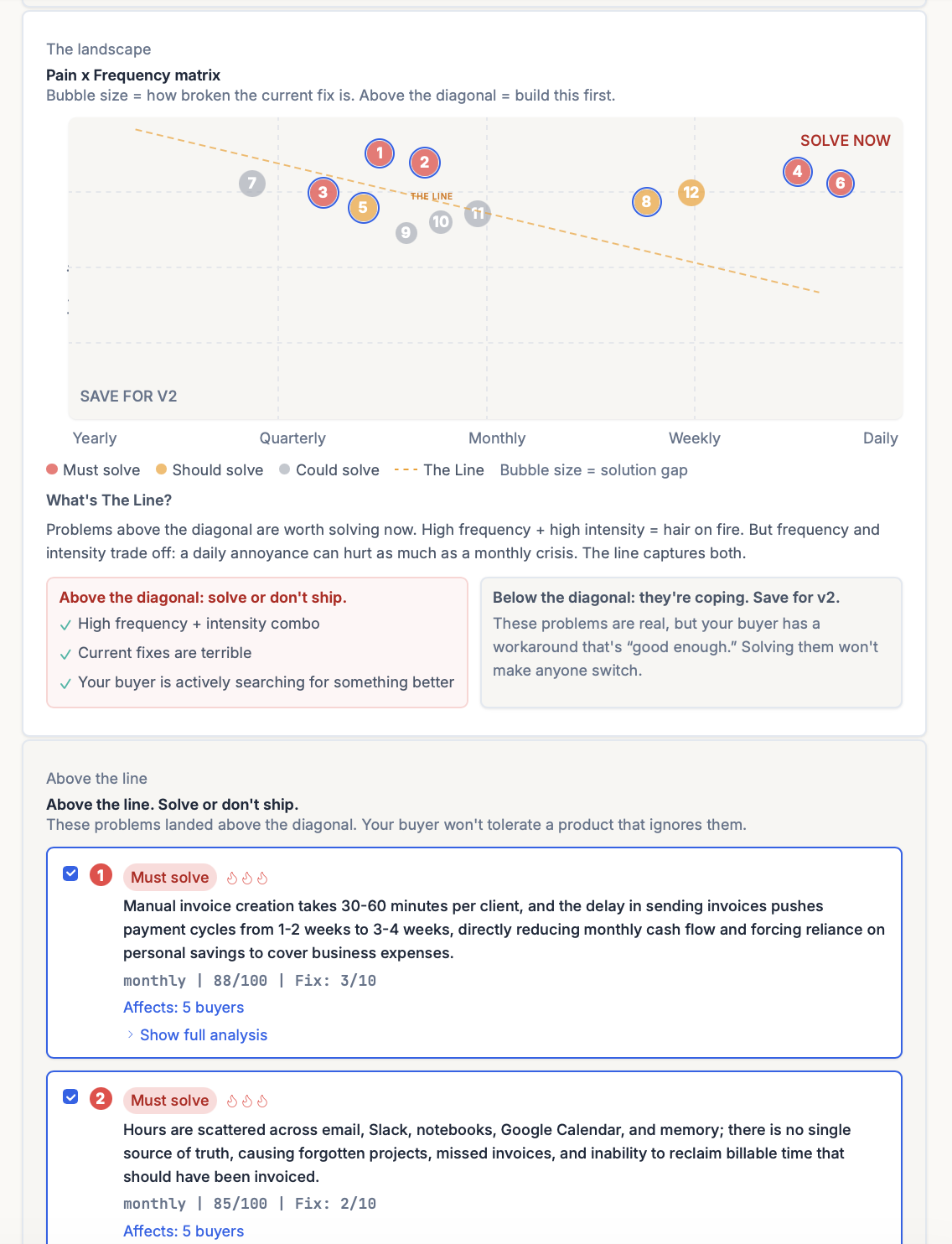
- 4
How to Win?
→ Solution approach 5–6 minDefine your unique value proposition and competitive moat that makes you the obvious choice.
Hamilton Helmer catalogued 7 sources of durable advantage. Most pre-PMF startups have zero; the question is which one you could build.
Deep-dive: Competitive analysisYou leave with- 3 solution approaches
- Problem-solution fit scores
- Risk assessment
Some of the frameworks usedHamilton Helmer's 7 PowersPorter's Generic StrategiesBlue Ocean Strategy (ERRC)Playing to Win (Martin & Lafley)Jobs-to-be-Done (Christensen)Disruptive Innovation TheoryCrossing the Chasm (Moore)Value Proposition Canvas (Osterwalder)Platform vs Pipeline (Van Alstyne)Aggregation Theory (Ben Thompson)Product-Led Growth (PLG)Sales-Led Growth (SLG)Community-Led GrowthLand and ExpandValue-Based PricingUsage-Based PricingFreemium StrategyStage 4 output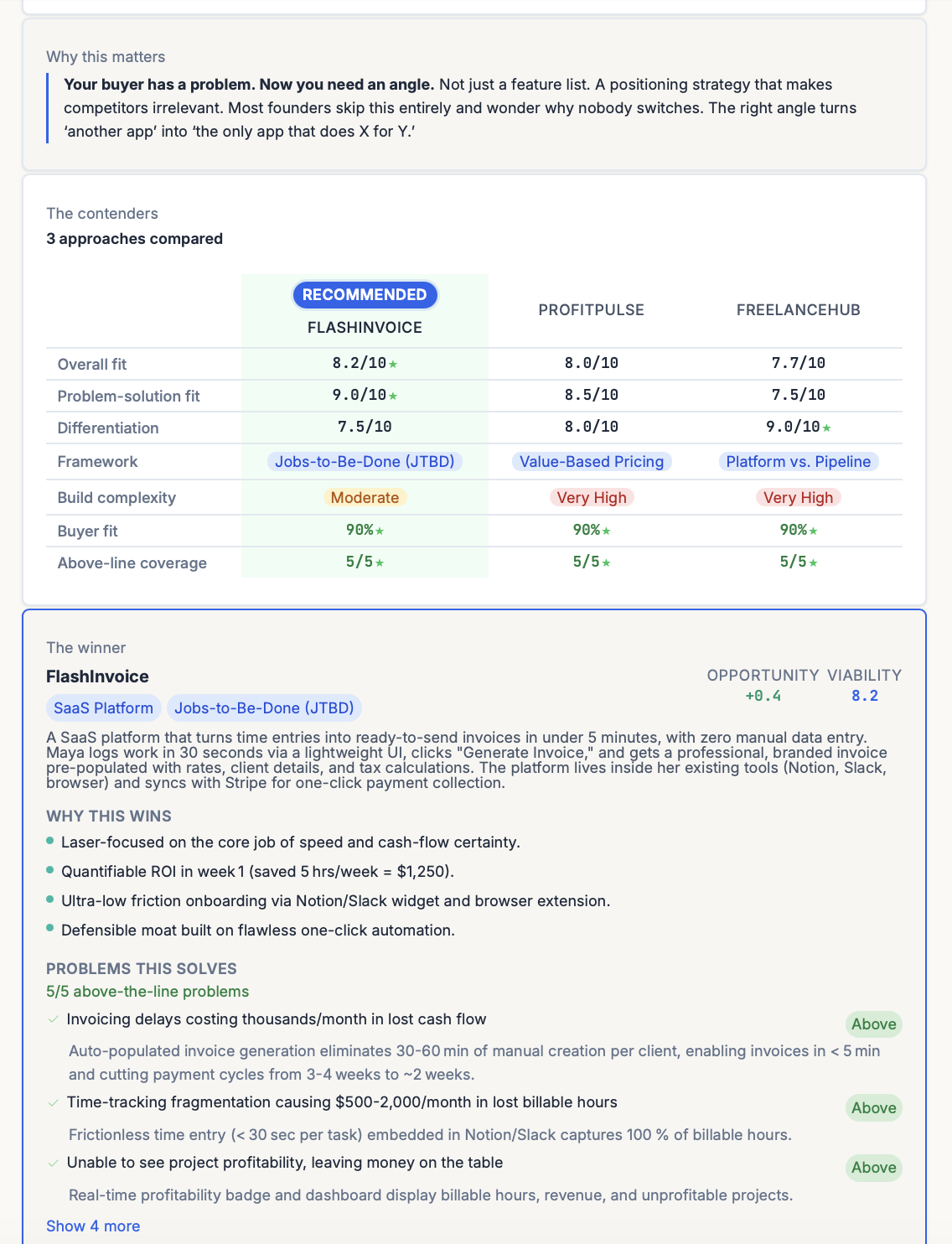
- 5
What's V1?
→ MVP scope 5–7 minScope the minimum viable product that proves your hypothesis without over-building.
MoSCoW caps the Must list at "cannot ship without". Three MVP packages emerge — Lean / Balanced / Full — so the scope/effort tradeoff is explicit before you commit.
Deep-dive: Scoping your MVPYou leave with- Feature matrix (effort × impact)
- MVP packages (Lean / Balanced / Full)
- Build vs buy decisions
Some of the frameworks usedUser Story & JTBD MappingSCAMPER MethodologyBiomimicryCross-Industry AnalysisFeasibility-Impact MatrixMVP Package Tiers (Lean / Balanced / Full)Customer Journey MappingAI Persona TestingStage 5 output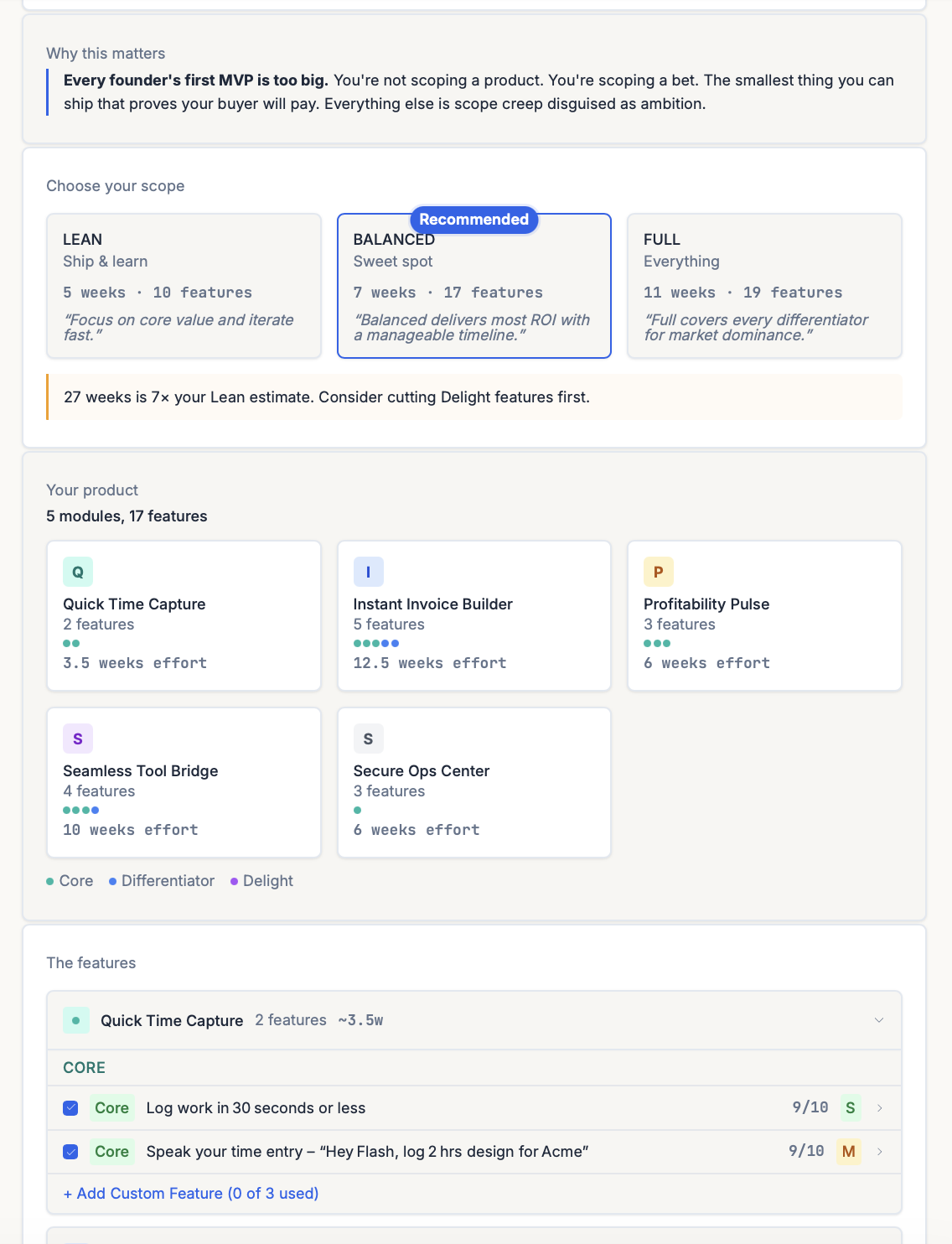
- Generate mine
See what your playbook looks like
No credit card. 3 free credits to start.
- 6
How to Charge?
→ Pricing model 4–5 minDetermine optimal pricing strategy based on value delivered and willingness to pay.
Van Westendorp PSM stabilizes around 30+ respondents in your ICP. Under that, curves lie; you produce a price that looks defensible but isn't.
Deep-dive: Pricing validationYou leave with- Pricing tiers with feature gating
- Competitive positioning
- Unit economics validation
Some of the frameworks usedVan Westendorp PSM (feature-weighted)Pricing Models by Product TypePain Intensity Premium ModifierConfidence Scoring FrameworkPersona-Price Fit ValidationStage 6 output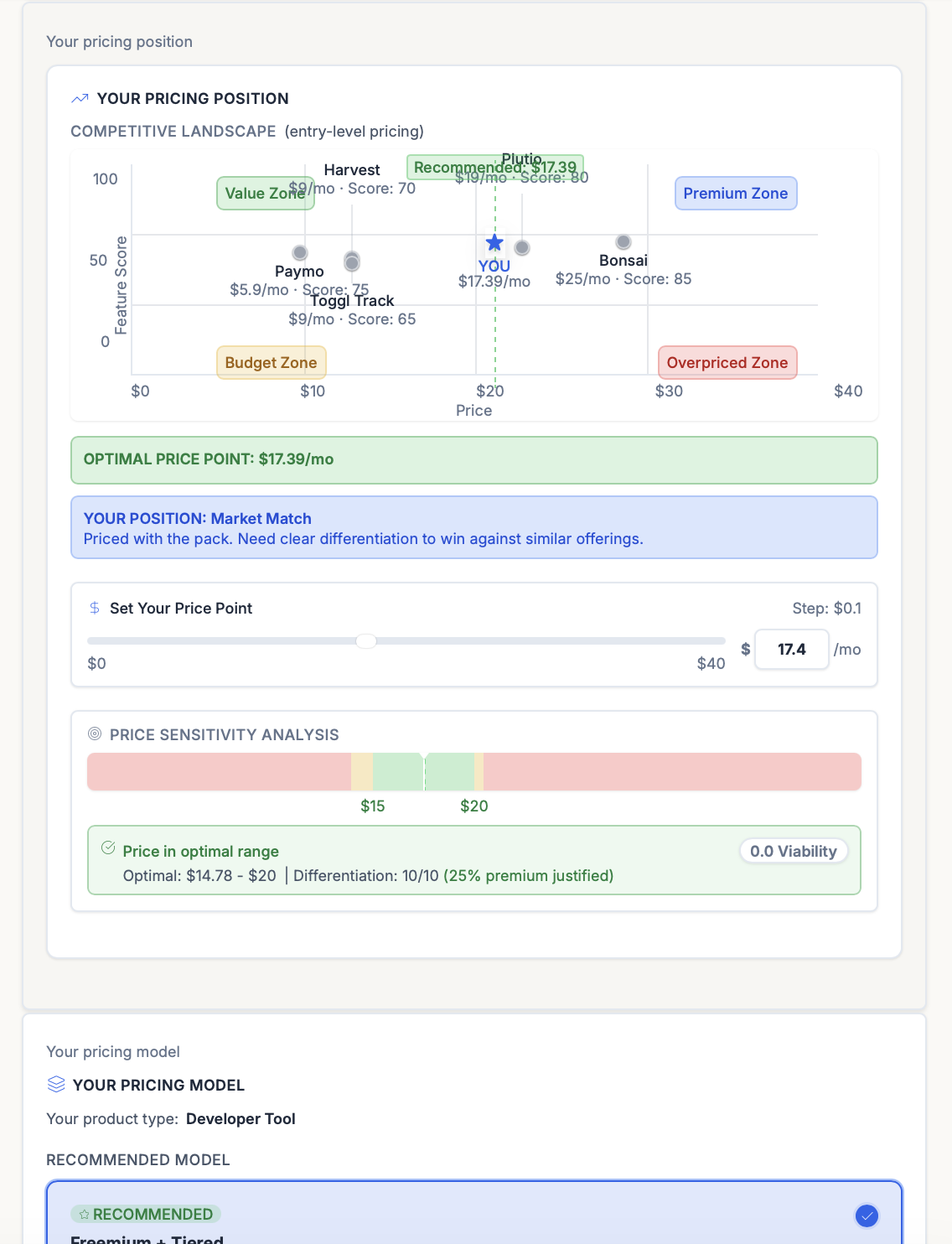
- 7
Will They Pay?
→ Demand proof 4–6 minPressure-test demand with smoke tests and behavioral signals before you build.
Fake Door signal tiers: a 1% Gold-tier conversion (real preorder / LOI / deposit) beats a 30% Worthless-tier conversion (email signup, upvotes).
You leave with- Smoke test plan
- Behavioral validation criteria
- Pre-sales playbook
Some of the frameworks usedFake Door TestingLanding Page Conversion FrameworkTraffic Warmth Levels (Cold / Mixed / Warm)Apology Modal PatternUTM Tracking FrameworkStage 7 output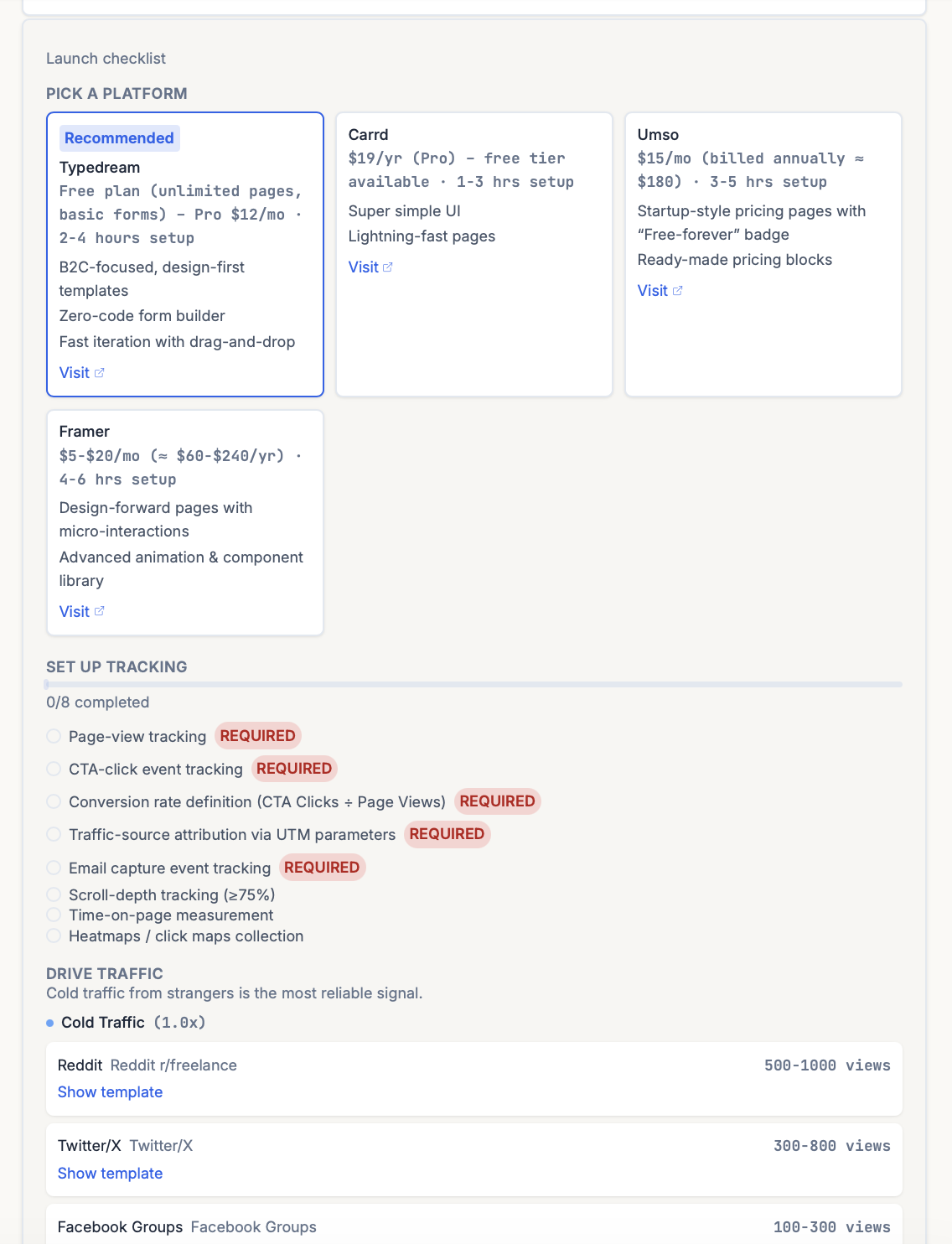
- 8
How to Launch?
→ GTM plan 6–8 minPlan your go-to-market strategy with specific channels, messaging, and launch sequence.
Test 2 channels deeply before adding a third. Founders who launch into 5+ channels at once spread budget too thin to learn from any single one.
Deep-dive: Building a launch planYou leave with- Prioritized launch channels
- Week 1 checklist
- Channel-specific messaging
Some of the frameworks usedGTM Strategy FrameworkDeep Persona ResearchBrand Strategy Framework (Positioning, Taglines, Voice)Channel Strategy (Organic, Paid, Partnership, Community)Product-Fit AnalysisMessage Bank CreationTimeline & Metrics PlanningStage 8 output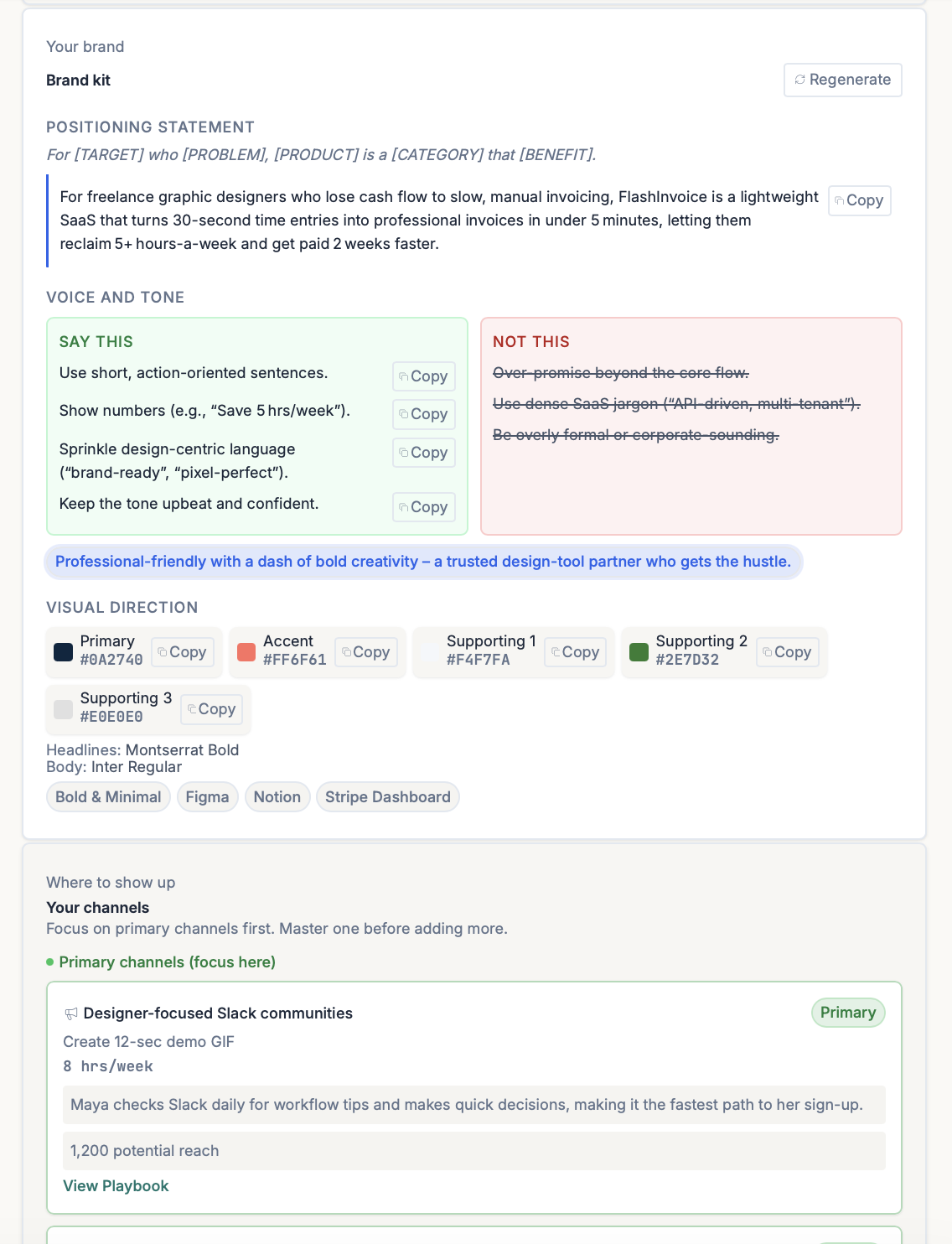
- 9
What to Export?
→ AI tool handoff 2–3 minGenerate optimized prompts and specs for Cursor, Claude Code, Windsurf, and other AI dev tools to accelerate development.
Exports to 7 AI dev environments: Cursor (.cursorrules), Claude Code (CLAUDE.md), Windsurf (.windsurfrules), Replit, Lovable, v0, Gemini — plus a Universal Prompt for any chat model.
Deep-dive: Validating with AIYou leave with- AI-ready prompts (Cursor, Claude Code, Windsurf, Replit, Lovable, v0, Gemini)
- Technical spec
- Launch assets
Some of the frameworks usedThree-Layer Architecture (Governance, Semantic, Operational)Context Engineering PrinciplesUniversal Prompt Variants (Minimal, Standard, Comprehensive)Tool-Specific Configurations (Cursor, Claude Code, Windsurf, Replit, Lovable, v0, Gemini)Stage 9 output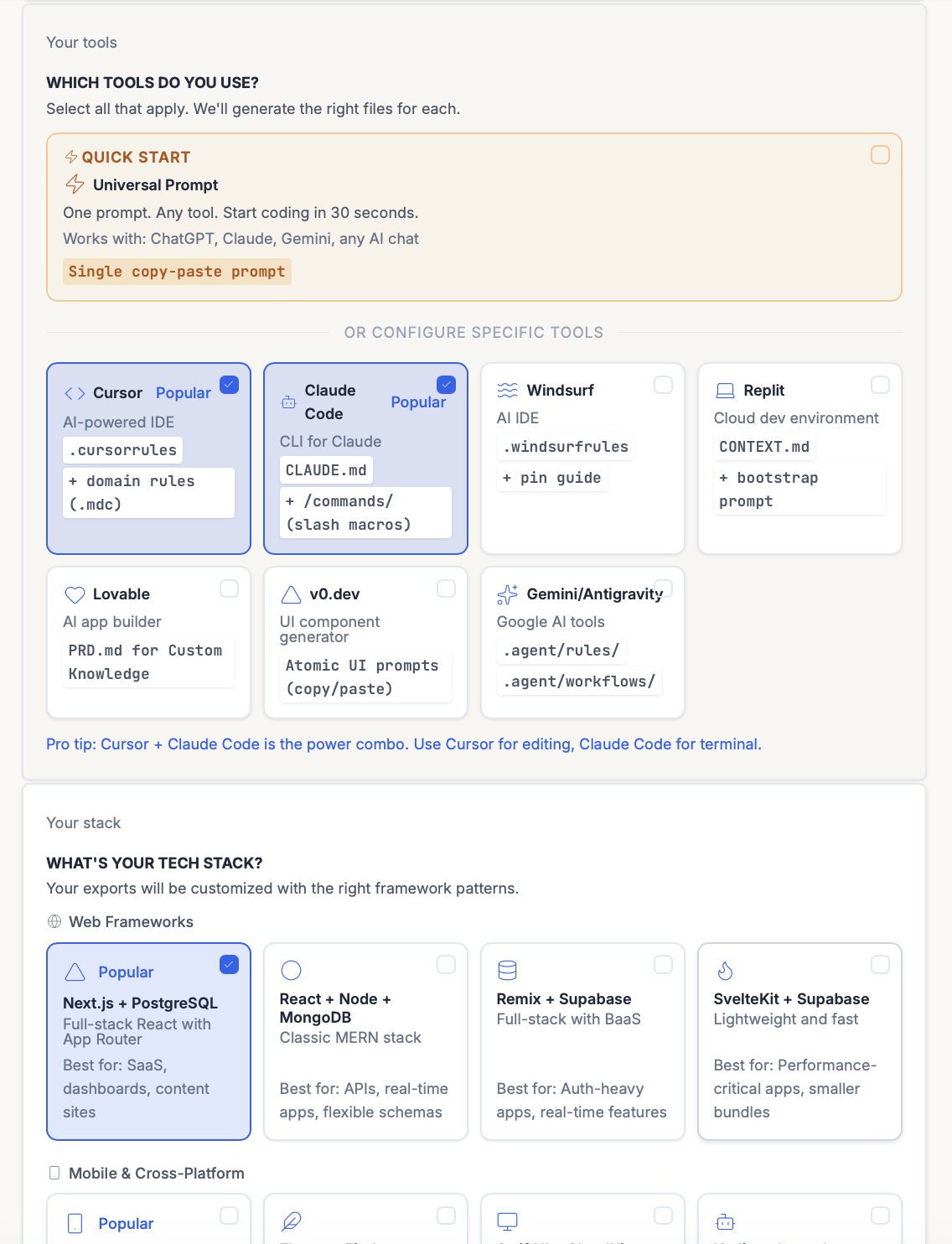


Why not just use ChatGPT?
You can ask ChatGPT about your idea and it'll tell you it's great. It always does. ShipFit's kill rate is 24%. ChatGPT's is 0%. Not because ShipFit is negative. Because it uses real market data, real competitor analysis, and proven frameworks that know which decisions actually matter.
ChatGPT gives you a conversation
Freeform chat. You decide what to ask. No structure. No sequence. No memory between sessions.
ShipFit gives you a playbook
Fixed 9-stage process. Each decision builds on the last. Cross-stage intelligence. Structured deliverables you build from.
Real data, not AI slop
Live competitor URLs. Sourced pricing. Real complaints from G2, Trustpilot, and app stores. Not training data from last year.
Frequently asked
How long does the full ShipFit flow take?
Do I have to do all 9 questions, or can I skip ahead?
What do I actually walk away with?
How is this different from just using ChatGPT?
What frameworks does ShipFit use?
Ready to make your next product a success?
9 decisions between your idea and a product worth building.